
Twin Falls County Release Meanings
A release from the Twin Falls County Sheriff’s Adult Detention Facility means that one county booking ended. It does not always mean the person went home. The Sheriff’s Arrest/Release report uses operational labels that identify the event or next custodian. Bond, OR, Credit Time Served, Charges Dismissed, Book & Release, Released, and Probation can reflect community exits. IDOC, Border Patrol, and Other Agency point to transfers. A transfer ends county custody while another authority may continue to hold the person.
The Headcount report answers a different question. It lists the Sheriff’s reported current population and may include offsite or treatment placements. A name missing from Headcount is not proof of release. The stronger local evidence is an Arrest/Release row with a matching name, date of birth, jacket number, booking time, release time, and release reason. Court conditions or probation can continue after the jail exit.
| Release label | What it means | Next check |
|---|---|---|
| Bond or OR | Pretrial release under financial or recognizance terms | iCourt and any pretrial supervision |
| Credit Time Served | Custody credit applied to that stay | Filed judgment and sentence |
| Charges Dismissed | A dismissal-related jail exit | Disposition in iCourt |
| Probation | Release may lead to local or IDOC supervision | County Adult Probation or IDOC |
| IDOC, Border Patrol, Other Agency | Transfer to another custodian | Identify and check the receiving agency |
Twin Falls County Release Record Fields
The official Warrants & Arrest Documents page links the weekday Arrest/Release report. It covers countywide agency bookings, court-sentenced bookings, book-and-release processing, and facility releases. The report is more useful than roster disappearance because it records an affirmative exit. It is not a full case history and contains no booking photograph.
| Field | What it shows |
|---|---|
| Jacket # | The Sheriff identifier used to distinguish records |
| Last, First Name and DOB | Identity fields that should be matched together |
| Booking Date | Date and time that the listed booking began |
| Release Date | Date and time that county custody for that booking ended |
| Hold Reasons | Custody basis shown in the export |
| Release Reason | Exit method or receiving authority in local shorthand |
A release reason is not a complete court ruling. Bond does not mean dismissal. Credit Time Served does not state every later duty. A court disposition supplies the lasting legal context, while the Sheriff row best documents the county transaction.
Request Twin Falls Release Records
Older or unclear events should go to Sheriff Civil Records or Detention Records. The Civil Records office requires the official Public Records Request Form for Sheriff, jail, and accident records. Some material requires approval. Ask separately for the booking and release sheet and the booking photograph, since the public PDF has no photo.
- Name the Sheriff or correct records custodian and provide requester details required by the form.
- Give the person’s full name, known aliases, date of birth when lawfully known, and a narrow booking or release range.
- Request the jacket number, admission and release timestamps, public release reason, public transfer destination, and booking photograph.
- Choose inspection or electronic copies. Ask for an itemized estimate before chargeable work begins.
- Keep any response or denial. It documents an authoritative absence, exemption, or referral.
425 Shoshone Street North
Twin Falls, ID 83301
208-736-4073 · Fax 208-933-4475
Idaho Code §§74-102 and 74-103 govern specific requests, declarations, timing, and fees. Resident requests are granted or denied within three working days, or written notice may extend the response to ten working days. Different statutory periods apply to nonresident requests. Those are response deadlines, not promises that every record will be produced at once. No fixed local photo fee or retention term was found, so request an estimate.
Twin Falls Release Court Records
The Idaho iCourt portal can explain what happened after a booking. Search by complete case number when possible, or use a party name and filters. Review Disposition Events, judgments, sentences, dismissal entries, probation orders, satisfaction, and discharge entries. A Bond or OR release and an open criminal case can both be true.
Idaho Court Administrative Rule 32 limits public access to sealed and exempt material. A no-result screen does not prove no case or no release. Idaho Code §19-2604 allows discretionary relief in qualifying adult cases. It is not automatic blanket expungement and does not promise deletion of each independent Sheriff or IDOC record.
The official iCourt public-search tutorial shows how the portal handles case searches.
The court system adds disposition and sentence context, but the Sheriff release sheet remains the better source for the precise county exit timestamp.
Find Twin Falls Released Inmates
Start with the custody type. County jail, state correction, federal custody, and immigration detention use separate systems. A current roster should never be treated as the sole released-person search.
- Open the Sheriff Arrest/Release report and search the surname. Match the whole row, including DOB, jacket number, booking date, release time, and reason.
- Compare Headcount only as a current-custody clue. Require an affirmative release event before concluding that county custody ended.
- For IDOC prison, reentry, parole, or felony probation, use the Idaho Resident/Client Search.
- Check iCourt for the legal disposition and sentence context. Use VINELink for a specific-person alert, not as a historical certificate.
- Follow transfers. Use ICE for Border Patrol language, BOP for federal prison records, or identify the Other Agency.
- Call the jail at 208-734-9090 for current operational confirmation, then request a durable record.
IDOC Twin Falls Release Search
The IDOC Resident/Client Search covers people in state custody or under court probation, parole, and other IDOC jurisdiction. Search by at least two letters of the last name or at least three digits of the IDOC number. First name is optional. Match birth year and identifiers instead of relying on the name alone.
| Status | Careful reading |
|---|---|
| In custody | The person remains in physical IDOC custody |
| In community | Outside prison but potentially under supervision |
| Active Bench Warrant | Verify warrant and supervising-office status |
| Discharged with date | IDOC jurisdiction ended on the shown date |
Discharged rows often do not open to old conviction details. An In community detail may show Released to Supervision, Sentence Satisfaction Date, Supervising District, and officer contact. Discharge can occur after a period of community supervision, so it is not always the prison-gate date.
The official search image below comes from the IDOC source.
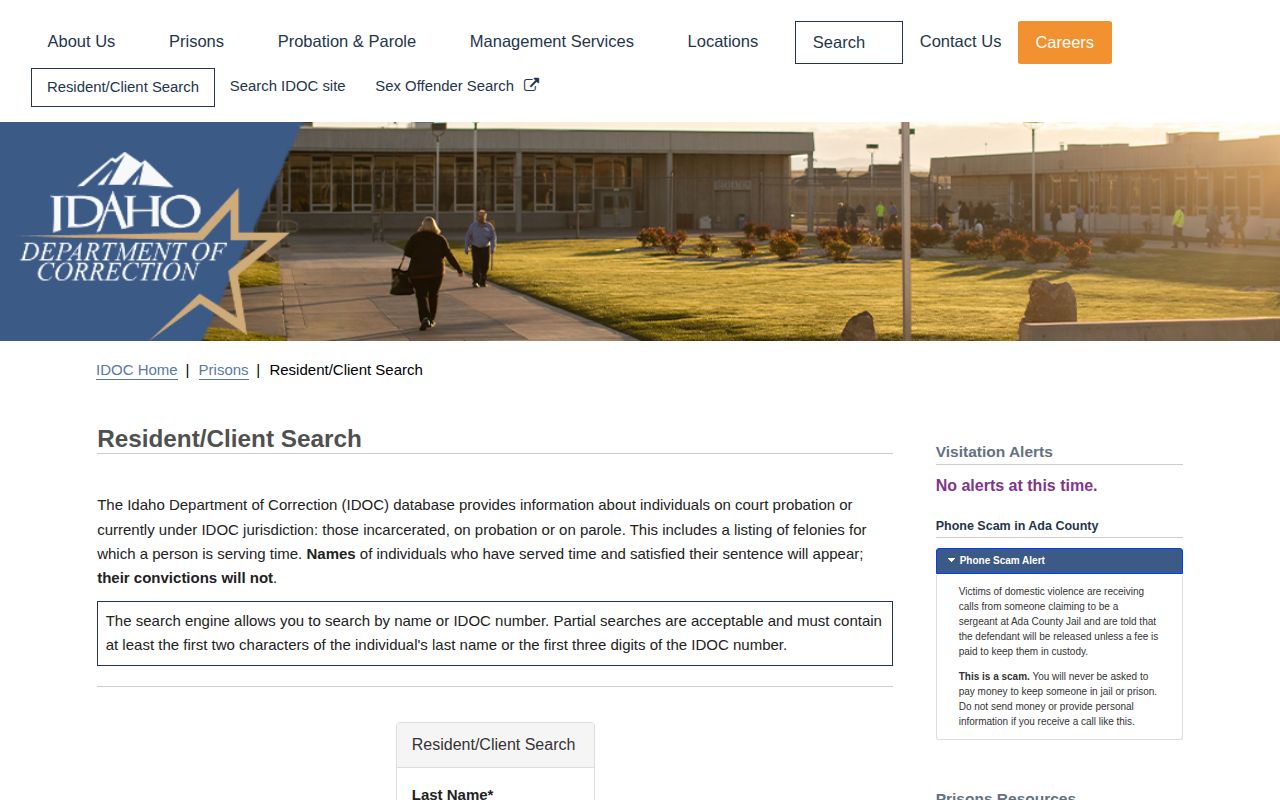
IDOC covers state cases. A short Twin Falls County jail stay with no IDOC case may never appear there.
Twin Falls Release Supervision Paths
Twin Falls County has two distinct community channels. County Adult Probation operates probation, a Pre-Trial Program, specialty-court support, monitoring, and related local services. IDOC District 5 supervises eligible state parole and felony probation clients. A Bond or OR row shows a jail exit, not a dismissal, and may lead to pretrial monitoring rather than an IDOC parole record.
For an IDOC record marked In community, review the supervising district and offense-row status. District 5 is at 731 Shoup Avenue West in Twin Falls and can clarify current state supervision. For a local court case, use the case number with County Adult Probation at 231 Fourth Avenue North. The right office depends on the court order and IDOC status.
Twin Falls Release Transfers
Local vocabulary makes transfers visible. IDOC means state correctional custody. Border Patrol points toward federal immigration custody. Other Agency requires identifying the recipient. These rows support the phrase “released from Twin Falls County custody to another authority,” not a claim that the person returned to the community.
The historic ICE agreement gives context for the county’s immigration-holding role. Current detention should be checked through the ICE Online Detainee Locator. Federal prison records belong in the BOP Inmate Locator. Neither replaces the Sheriff record for the county exit.
Twin Falls Custody Location Changes
Local crowding changes how roster results should be read. KMVT reported 328 people against 254 beds in 2025. In 2026, reporting described about 340 people, roughly 100 over capacity, about 100 IDOC inmates, and a planned 165-bed project. A later report documented a 30-person move to IDOC. These facts explain why “not in this building” is not the same as released.
Headcount can also show another jurisdiction or treatment location. Match time stamps and jacket numbers when reports conflict. The agency competent for the later custody stage supplies the next status.
Twin Falls Reentry Is Custody
The Twin Falls Community Reentry Center is an IDOC facility for up to 160 minimum-custody men nearing release. Residence there remains In custody even when structured community activity is allowed. Later In community status with Released to Supervision can support community placement. Discharged means IDOC jurisdiction ended.
TARC is a separate county treatment and recovery navigation resource. Its role should not be confused with the state reentry center or used as proof of any person’s status.
Twin Falls Release Facilities
The adult county jail, state reentry center, and juvenile center each use a different release path. Adult release events may appear in the Sheriff PDF. State reentry status belongs to IDOC. Juvenile information follows confidential parent, guardian, court, and facility processes.
- Twin Falls County Sheriff’s Adult Detention Facility: county release sheet, jail confirmation, and records request.
- Twin Falls Community Reentry Center: IDOC status, Commission action when relevant, and District 5 supervision.
- Snake River Juvenile Detention Center: confidential juvenile channels, not adult reports.
Twin Falls Release Alerts
VINELink can check one matching person and register for alert methods offered on that record. Select Idaho, enter a name or ID, compare identifiers, open the record, and read the displayed custody status and location. Registration is tied to that person or case. Phone registration uses a four-digit PIN to acknowledge automated calls. Email or text registration follows the confirmation shown by the service.
VINE is an alert system, not a certified archive. A released status may describe bond, sentence completion, transfer, or another event from the feeding agency. The Idaho Commission currently warns that VINE services for IDOC are inactive. Direct IDOC search and IDOC or Commission victim-notification channels are therefore required for state prison and parole matters. County and court coverage should not be treated as proof of live state-prison alerts.
Twin Falls Release Terms
Agency labels matter because they describe different points in a case and sentence. Using the exact term prevents a search result from promising more than it proves.
- County release
- Twin Falls County ended the listed booking, either to the community or another authority.
- Parole
- Community supervision after a period of state custody and a Commission decision.
- Probation
- Court-ordered supervision that may begin without a prison term.
- Discharge
- IDOC jurisdiction ended on the displayed date.
- Detainer
- Another authority has asked that custody or transfer continue.
Sentence Satisfaction Date is a scheduled state sentence end, not always the physical exit date. Parole Eligibility Date means a person may be considered, not that parole was granted. A Tentative Parole Date remains conditional until requirements, plan approval, and paperwork are complete.
Twin Falls Release No Results
A no-result screen is not a release finding. It may reflect a spelling variation, an old or replaced report, delayed data, a protected record, a sealed case, a transfer, a discharged IDOC row with limited detail, or a person outside that system. Retry the official spelling and case or jacket number. Then move to the source that covers the correct custody type.
Affirmative proof has a positive event: a Sheriff release timestamp and reason, an IDOC Discharged date, an In community record paired with Released to Supervision, a filed court disposition, or a federal locator status with its stated limits. When sources disagree, preserve their dates and ask the competent custodian to resolve the difference.
Twin Falls Release Timing
Twin Falls County publishes no fixed adult release hour. The sampled report contains events at varied times, including overnight and near midnight, but that observation is not a formal schedule. Court orders, bond processing, record checks, detainers, transport, and receiving-agency coordination can all change an estimate. Wait for affirmative jail confirmation before arranging travel.
No authoritative source identifies the public release door, a family waiting area, curb rules, or weekend and holiday pickup instructions. Call the jail and follow staff directions. Emergency and nonemergency dispatch should not be used for routine record research or pickup planning unless the Sheriff directs it. Ride TFT is a city transport option to investigate after the time and place are confirmed, not a promised jail ride.
Twin Falls Release Property
No published adult jail policy in the research sets out property return, unclaimed-property retention, replacement identification, gate money, or a standard release checklist. Those unknowns should become direct questions to the jail or Detention Records. Do not import a state prison practice or another county’s rule.
Corrections belong with the agency that created the disputed information. Sheriff record issues go to Sheriff records staff. Court docket issues go to the clerk or court process. IDOC record issues go to IDOC. Juvenile departure rules remain separate; the Snake River center’s medication-return instruction does not apply to adults.
Twin Falls Release Request Details
A focused request is more likely to reach the right record without avoidable review. Name Twin Falls County Sheriff’s Office as the agency and identify the booking by full name, DOB when lawfully known, approximate admission date, and jacket or court case number. State the exact date range. Ask for the booking and release sheet, admission and release timestamps, public hold and release reasons, and the receiving agency when a transfer destination is public. Request the booking photograph as a separate item because it is not part of the published Arrest/Release report.
Idaho Code §74-102 requires a specific request and the current requester details and residency declaration. For Idaho residents, the statute provides the first two labor hours and first 100 paper pages without charge unless another lawful fee applies. Actual costs can apply beyond those limits, for redaction, or under an authorized schedule. Nonresident rules differ. The agency may require advance payment and should itemize fees. Twin Falls County does not post one fixed local release-sheet or photo price, so an estimate is more accurate than an assumed amount.
Idaho Code §74-103 sets response periods. A resident request is granted or denied within three working days, or the custodian provides written notice before an extension of up to ten working days. Current law provides longer periods for a nonresident request. A partial or full denial must cite its authority and appeal rights. Law-enforcement investigatory, victim, juvenile, sealed, and other protected material may be redacted or withheld under the Public Records Act and court rules. A lawful redaction does not erase the value of the public release timestamp and reason.