
Twin Falls Parole Versus Probation
Parole and probation both allow a person to live outside a jail or prison under rules, but they begin in different ways. Parole follows a period in IDOC custody and is granted by the Idaho Commission of Pardons and Parole. Probation is imposed by a court. It may begin without a prison term. Twin Falls County also runs a Pre-Trial Program, so a person released on bond or their own recognizance may face monitoring without being on either state parole or felony probation.
| Status | How it begins | Primary Twin Falls source |
|---|---|---|
| Parole | Commission release after a custody term | IDOC search and District 5 |
| State probation | Court order within IDOC jurisdiction | IDOC search, District 5, and iCourt |
| County probation | Local court outcome | County Adult Probation and iCourt |
| Pretrial monitoring | Bond or recognizance release before disposition | County Pre-Trial Program and case docket |
Do not infer the status from a Sheriff release reason alone. “Probation” on an Arrest/Release row records the jail transaction, not every condition or the office now responsible. “In community” in the IDOC Resident/Client Search is also not final discharge. Open the detail and read the offense status, Released to Supervision date, supervising district, and Sentence Satisfaction Date.
- Parole
- Conditional community placement after prison custody.
- Probation
- Court-ordered supervision that may replace or follow confinement.
- Discharge
- The end of IDOC jurisdiction shown by a dated discharged status.
- Absconder
- A supervised person alleged to have stopped reporting or left supervision without approval.
Verify Twin Falls Release Supervision
Start with identity and case type. IDOC accepts at least two letters of a last name or at least three digits of an IDOC number. First name is optional. Results may say In custody, In community, Active Bench Warrant, or Discharged with a date. A short county jail stay with no IDOC case may not appear, so a missing result must lead to the court and county channels.
- Search the official IDOC database and match name, birth year, and IDOC number.
- Open an In community result. Note whether the sentence row says Probation or Parole, then record the case number and supervising district.
- Search the case in Idaho iCourt. Disposition events can show the court order behind probation or later changes.
- Call the office shown on the current IDOC detail. For District 5, use the local Twin Falls office. For county-level probation or pretrial monitoring, contact Twin Falls County Adult Probation.
- If the result says Discharged, treat the displayed date as the end of IDOC jurisdiction. Request historic records when the physical release date or former supervision terms matter.
Daily database updates can trail an immediate event. Save the date and “data current as of” time, then ask the supervising office to define any unclear field. Officers may limit what they disclose. Public IDOC and court fields still provide a sound baseline for confirming which agency holds authority.
Twin Falls Supervision Offices
Two local offices serve different caseloads. IDOC District 5 mirrors Idaho’s Fifth Judicial District and covers eight counties, including Twin Falls. It handles IDOC community clients. County Adult Probation manages its own probation, Pre-Trial Program, specialty-court services, referrals, testing, electronic monitoring, and work detail. A case number and the exact status from IDOC or iCourt help staff route a question.
Twin Falls County Adult Probation
231 Fourth Avenue North
PO Box 126
Twin Falls, ID 83303
208-736-4230
Monday through Friday, 8 a.m. to 5 p.m.
Twin Falls Warrants After Release
A supervision violation is an alleged breach of a release rule. It does not by itself explain the final court or Commission result. IDOC may show Active Bench Warrant. Its Fugitive Recovery page also publishes a selective Most Wanted list, but that list does not include every person with a warrant. The Sheriff posts a separate active-warrant PDF and warns that served, withdrawn, weekend, and same-day changes may not yet appear.
Absence from either list is not proof of compliant supervision. Confirm the IDOC detail, court docket, and responsible office. A person with an active warrant may be outside physical custody while still subject to arrest. IDOC accepts anonymous fugitive tips at 208-658-2167. Routine record questions belong with the office, not emergency dispatch.
Twin Falls Supervision Discharge
Supervision ends through an agency or court action, not merely because a person no longer appears on one list. IDOC’s strongest public end marker is “Discharged” followed by a date. That date means the displayed state sentence and IDOC jurisdiction ended. It may be later than the day the person left a prison because parole or probation can continue in the community.
For a county case, read iCourt disposition events and ask the clerk for a filed or certified order. For the release from the county jail itself, use the Sheriff’s release row or request the booking and release sheet. The Twin Falls County released-inmate search explains how those county, court, and state records fit together. A missing record is not a discharge finding.
Twin Falls Reentry Remains Custody
The Twin Falls Community Reentry Center holds up to 160 minimum-custody men who are nearing release. Residents can take part in structured community activity, but residence there remains IDOC custody. It should not be described as parole, probation, or community release merely because the building is local and has a reentry role.
After actual placement outside custody, an IDOC record may change to In community and show Released to Supervision plus District 5. The county’s TARC program is a separate treatment and recovery navigation resource. Neither facility name proves that a particular person receives a service. Check the individual’s official record and the agency responsible for it.
Twin Falls Parole Decision Records
The Idaho Commission, not IDOC, decides discretionary parole. Its weekly hearing schedule identifies hearing date, type, IDOC number, and name. The decision page publishes Notices of Action Taken. Outcomes include grant, deny, continue, revoke, and grant to detainer only.
A Tentative Parole Date follows a grant but stays conditional. Programming, plan approval, and final paperwork can change it. “Grant Parole to Detainer Only” means transfer to another authority. Confirm actual placement later through In community and Released to Supervision. A hearing date or favorable vote alone does not prove the person has left custody.
The Commission’s decision layout can be reviewed at its official source.
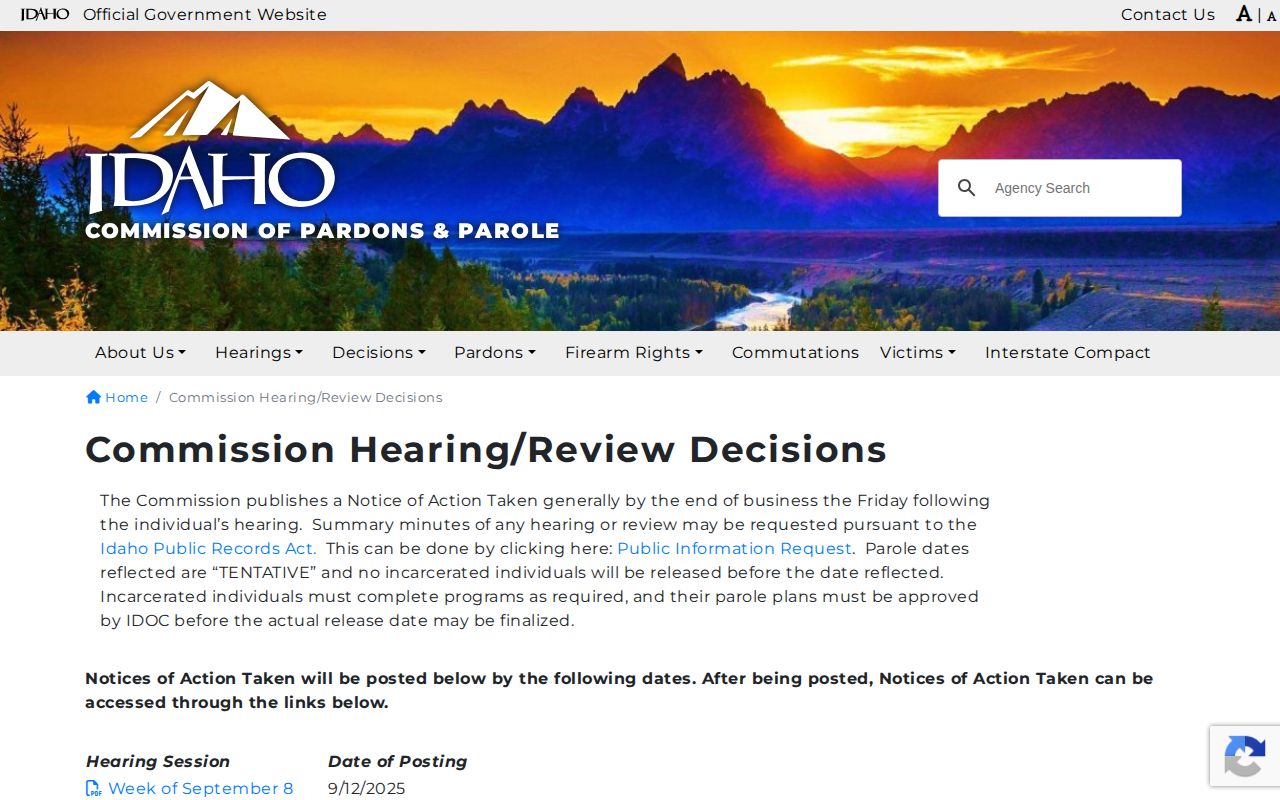
The image illustrates where the action and tentative date are found, while a later IDOC status supplies the needed movement check.
Search Public Records
Sponsored Results
Twin Falls Supervision Record Conflicts
Supervision records should be ranked by the fact each office can establish. The filed court judgment controls the sentence and probation order. IDOC controls its public correctional status, supervising district, and state sentence fields. The Commission controls parole decision wording. County Adult Probation controls its local caseload and Pre-Trial Program. A Sheriff release row establishes the jail transaction, but it does not replace any of those later records.
When sources disagree, preserve both dates and update times. A person can leave the county jail on bond, enter local pretrial monitoring, and later receive a court disposition. Another person can leave prison for parole, appear In community under District 5, and reach final discharge much later. Those are separate events. Calling every event “released” would erase the supervision that still exists.
A no-result screen also needs care. A short county case may never enter IDOC. A person may be listed under a spelling variant, a transferred case may require the district office, and a court record may have restricted access under Rule 32. Ask the correct office about its own record instead of treating silence in one system as proof about all systems.
Twin Falls Release Status Evidence
An IDOC In community detail can show the supervising district, office address, officer, phone, sentencing county, case number, Probation or Parole status, Released to Supervision date, and Sentence Satisfaction Date. Capture those labels exactly. An officer name can change, so use the current record and office contact rather than publishing a stale assignment as permanent.
For an immediate change, call District 5 because IDOC says public data updates daily and may not be current. For a local bond or recognizance release, check iCourt and County Adult Probation instead. Bond means release under financial terms. OR means release on personal recognizance. Neither proves dismissal, and neither automatically creates an IDOC parole record.