
Twin Falls Scheduled Versus Actual
A future date can mark sentence satisfaction, parole eligibility, a hearing, or a conditional parole plan. None automatically proves the day or hour someone will leave. A pretrial detainee has no fixed release date because bond, dismissal, plea, trial, and court orders remain unresolved. A sentenced person may have calculable terms, yet detainers and later orders can change the physical destination.
Twin Falls County jail records and Idaho state records describe different systems. The Sheriff report can show a completed county release. IDOC displays sentence and supervision fields for state jurisdiction. A person moved to IDOC, Border Patrol, or another agency has left county custody but has not necessarily entered the community.
Find Twin Falls Release Dates
Begin with the custodian. IDOC does not publish a field literally named Projected Release Date. Its exact future fields are Sentence Satisfaction Date, Parole Eligibility Date, and sometimes Next Parole Hearing Date. The Commission uses Tentative Parole Date only after an action.
- Use the IDOC Resident/Client Search for state custody or community supervision.
- Match the name, birth year, and IDOC number, then open an active record.
- Read the sentence row, fixed term, Sentence Satisfaction Date, and Parole Eligibility Date exactly.
- Check the Commission decision if parole was considered.
- For a county sentence, read the filed judgment in iCourt and request the jail’s applied-credit calculation.
- Recheck the responsible agency when the date arrives.
A short local stay may never appear in IDOC. The Twin Falls County release-record search explains the Sheriff report and records request for those cases.
Idaho Release Date Computation
Idaho does not use a generic 85-percent rule for this calculation. Under Idaho Code §19-2513, a unified sentence includes a fixed or determinate period and may add an indeterminate period. Ordinary parole does not occur during the fixed portion. Consecutive terms and offense-specific minimums can change which date controls.
Current §20-101D is not routine earned time. It permits limited IDOC reductions for extraordinary heroism or outstanding service and allows withdrawal. The monthly good-conduct deductions in §20-101A apply to offenses committed before July 1, 1986. Applying that legacy schedule to a current sentence would create a false date.
County jail sentences follow the controlling court order and jail-applied credits. No Twin Falls Sheriff county good-time formula was found. Ask Detention Records for the actual calculation instead of importing state prison rules.
Why Twin Falls Dates Change
A displayed date must be read with the judgment, custody type, and latest agency action. Some events change timing. Others change destination rather than the end of county custody.
| Factor | Effect |
|---|---|
| Court order or amended judgment | Changes the legal term or applied credit |
| Consecutive sentence | May move the controlling full-term point |
| Parole grant | Creates a conditional tentative date, not a guaranteed exit |
| Parole denial | May point the case toward sentence satisfaction |
| Detainer | Can produce transfer to another custodian |
| Legacy or exceptional credit | Applies only when the governing statute and agency action support it |
“Grant Parole to Detainer Only” is a transfer. “In community” is not final discharge. “Discharged” with a date is the public IDOC marker that jurisdiction ended, though the physical prison exit may have occurred earlier under supervision.
Confirm Twin Falls Actual Release
For county custody, call the jail at 208-734-9090 and request a booking and release sheet when a durable time and reason are needed. For IDOC, look for In community plus Released to Supervision after a parole placement, or a dated Discharged result at the end of jurisdiction. Capture the database’s current-as-of time because status can lag an immediate move.
A VINELink release check can supply an alert where the feed is active, but the Commission currently says IDOC VINE service is inactive. Use direct IDOC and Commission channels for state cases. Court disposition gives sentence context, while the Sheriff release sheet gives the more precise county exit event.
Twin Falls Fixed-Term Release Math
Idaho’s fixed-plus-indeterminate structure makes a plain sentence total misleading. Read the judgment’s fixed portion first. Then account for consecutive fixed terms and any mandatory minimum. Compare that result with IDOC’s Parole Eligibility Date and Sentence Satisfaction Date. A Next Parole Hearing Date is only an appointment.
If the Commission grants parole, read its Tentative Parole Date and all conditions. Plan investigation, required programming, and final paperwork can delay or void placement. A denial and pass to full term points toward sentence satisfaction unless a later lawful action changes the result.
The official offender-search layout shows where state status begins.
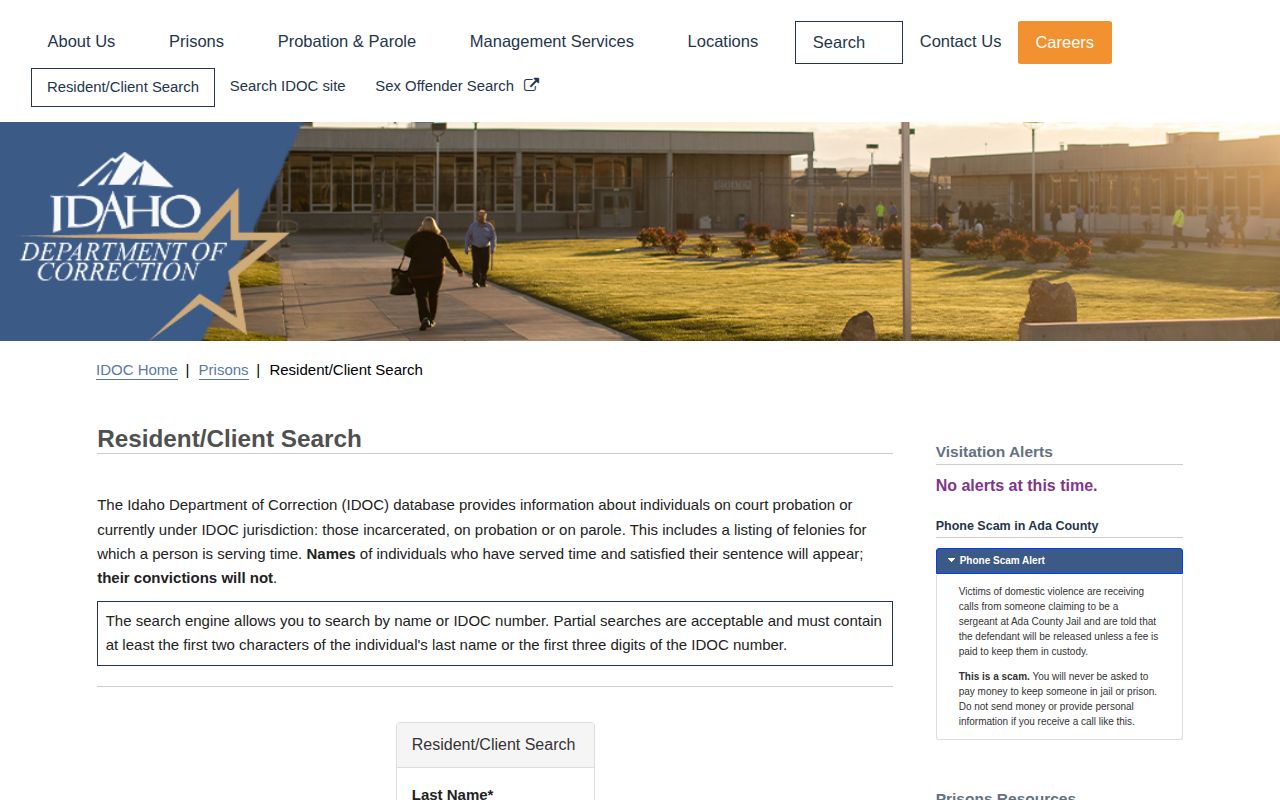
The search result must be paired with the judgment and Commission action before treating any future date as meaningful.
Twin Falls County Sentence Credits
A county sentence needs the filed judgment and the jail’s application of credit. “Credit Time Served” in the Sheriff report is a release reason tied to that transaction. It does not provide the full arithmetic or resolve later supervision. Ask Detention Records for the calculation and use iCourt for the legal sentence.
No published Twin Falls policy establishes a standard weekend advance, fixed release hour, or county good-time formula. Sample events occur at varied times, including overnight, but that is not a promise. Court orders, bond processing, record checks, transportation, and receiving-agency coordination can make the actual exit differ from an estimate.
Do not travel based only on a projected date. The research found no public release door, family waiting site, or weekend pickup rule. Call the jail and follow staff instructions after affirmative confirmation.
Read Twin Falls Date Labels
- Sentence Satisfaction Date
- The scheduled end of active IDOC sentence information.
- Parole Eligibility Date
- The earliest ordinary parole-consideration point, not a grant.
- Next Parole Hearing Date
- A scheduled proceeding, not an exit date.
- Tentative Parole Date
- A conditional Commission date after a grant.
- Released to Supervision
- A past community placement under continued control.
The Commission action and IDOC record can refer to one case but prove different events. The decision proves what was ordered. The later IDOC status helps confirm whether placement occurred. The Sheriff report proves only a county transaction.
Search Public Records
Sponsored Results
Twin Falls Parole Date Evidence
The Commission schedule is a planning source. It posts hearing dates, type, IDOC number, and name, and the order can change. The decisions page is stronger for the action itself. A Notice may say Grant Parole, Grant Parole to Detainer Only, Deny, Continue, Revoke, or Deny and Pass to Full Term Release Date.
Record the exact action. A grant to detainer only points to another custodian. A denial and pass to full term suggests custody through sentence satisfaction unless a later lawful change occurs. Neither PDF proves the eventual physical exit. On or after a tentative date, recheck IDOC for In community and Released to Supervision.
A Discharged result confirms the end of IDOC jurisdiction. It may not equal the prison gate date because the person could complete the last part under community supervision. Request historic IDOC records when that distinction matters.
Twin Falls Release Record Sequence
Keep the sources in time order: judgment, sentence fields, Commission action, later IDOC status, and completed release record. Record each source’s update time. If two official records conflict, preserve both observations and ask the competent agency to explain them. A newer page is not always the better source for an older event.
For a county case, the Sheriff exit timestamp outranks roster disappearance. For a state sentence, IDOC controls correctional status while the Commission controls parole decision wording. The court controls the filed judgment. This sequence prevents a planned date from being reported as a completed release.
Twin Falls Pretrial Release Timing
A pretrial detainee does not have a computed sentence end. Release may turn on bond processing, an OR order, dismissal, a later hearing, or another court direction. The Sheriff Arrest/Release report can confirm the completed exit transaction, while iCourt supplies the legal case events. Neither a scheduled hearing nor a bond amount predicts the exact door time.
Hold reasons also matter. A detainer is a request or authority that can keep a person for another custodian after the local matter changes. IDOC, Border Patrol, and Other Agency release reasons identify movement away from county custody. They do not support a promise that the person will be free at a projected hour. Identify the receiving agency and use its locator or records channel.
For a county sentence, ask the jail for the applied-credit calculation and compare it with the filed judgment. The public Sheriff materials give no standard county good-time formula, weekend adjustment, or fixed processing schedule. That absence is a valid local finding. It requires confirmation rather than borrowed arithmetic.
Twin Falls Consecutive Sentence Review
Multiple Idaho sentences can make the controlling date case-specific. Read whether terms run at the same time or consecutively, then identify each fixed portion and any mandatory minimum in the judgment. Parole Eligibility Date does not override a fixed term. A hearing six to nine months before eligibility, which IDOC describes as common for initial scheduling, is still only a hearing.
Sentence Satisfaction Date is the planned full-term point shown for active sentence information. A later amended judgment, Commission action, or authorized exceptional credit can alter the path. Routine subtraction of monthly good time is wrong for current offenses because §20-101A is legacy law. Section 20-101D addresses rare meritorious service, not ordinary conduct credit.
Twin Falls Date Confirmation Calls
Ask a narrow question of the office that owns the record. The jail can address present county custody and route a request to Detention Records. District 5 can clarify current state community supervision. IDOC central records can address historic state custody. The Commission can explain its action language, while the court clerk can provide the filed judgment or certified disposition.
Record who supplied the answer, the date, and the exact field or document discussed. Do not turn an estimated date into a guaranteed event. Recheck after the date for an affirmative release timestamp, In community placement, or Discharged result.